Choosing a Lens for Cataract Surgery
The surgery is routine. The lens you choose is what you live with afterwards, and the right answer depends more on how you spend your day than on which lens is newest.
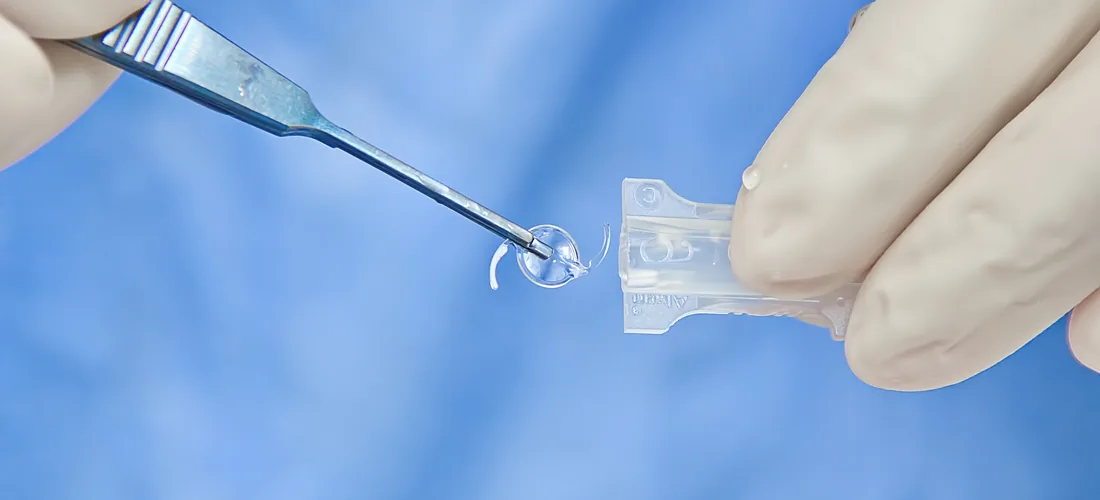
Cataract surgery removes the eye’s clouded natural lens and replaces it with an artificial one. The surgery itself is well established. The decision that shapes your vision for the rest of your life is which lens goes in, and that decision is yours to make with your surgeon, not one to be handed over.
The lens types
Monofocal
A monofocal lens gives sharp vision at a single distance. Most patients set it for distance and use reading glasses for close work.1 It is the most widely used lens, it is what insurance generally covers, and it produces the cleanest optical result of any option. Choosing it is not settling for less. For a patient who drives at night, it is often the better lens.
Multifocal
A multifocal lens has several corrective zones built into it, working much like a bifocal or trifocal spectacle lens, so the eye can focus at more than one distance.1 For many patients this means far less dependence on glasses. The trade-off is optical: splitting light between zones can produce glare, halos around lights and reduced contrast, particularly at night.1
Extended depth of focus (EDOF)
An EDOF lens stretches a single zone of focus to cover distance and intermediate range, which is useful for computer work. It carries broadly the same night-vision considerations as a multifocal.1
Toric
A toric lens corrects astigmatism, and is available as a monofocal and in some presbyopia-correcting designs.1 If you have significant astigmatism and choose a lens that does not correct it, you will still need glasses for clear distance vision after surgery.
Comparing the trade-offs
| Lens | Good for | Main trade-off |
|---|---|---|
| Monofocal | One distance, cleanest optics, night driving | Reading glasses needed |
| Multifocal | Least dependence on glasses overall | Glare, halos, reduced contrast at night |
| EDOF | Distance plus screen-range vision | Similar night-vision effects; near vision may still need help |
| Toric | Correcting astigmatism | Needs precise alignment; costs more |
The question that decides it: how much do you drive at night? Patients who drive after dark frequently often do better with a monofocal lens, even though it means reading glasses.1
Questions worth bringing to your consultation
- What do I spend most of my day looking at: a road, a screen, or a page?
- How often do I drive at night, and how much would halos around headlights bother me?
- Do I have astigmatism, and does the lens being proposed correct it?
- Do I have any other eye condition, macular or corneal, that would limit what a premium lens can deliver?
- What is covered by my insurance, and what is the difference out of pocket?
That fourth question matters more than it looks. A multifocal lens cannot overcome a retinal problem, and a patient with macular disease may pay a premium for a benefit the eye cannot use.
Measurement matters as much as the lens
The power of the lens implanted in your eye is calculated from measurements taken before surgery: the length of the eye and the curvature of the cornea. Those measurements are what determine whether you hit the refractive target. Optical biometry is the standard tool for this, and it is why a thorough pre-operative workup is not an upsell but the foundation of the result.
Talk through your lens options
Bring your daily routine to the consultation. It tells us more about the right lens than any brochure.
Book an AppointmentSources
- American Academy of Ophthalmology. Factors to Consider in Choosing an IOL for Cataract Surgery. aao.org
- American Academy of Ophthalmology. Intraocular Lenses (IOL) for Cataract Surgery. aao.org
This article is general information, not medical advice. Findings vary from person to person, and only an examination can tell you what applies to your eyes.